
Why is it difficult to build community in the city?
The origins of modern urban loneliness and building community in the city
In the past, people would go to the same grocer, sit in the same café, and walk the same street. Acquaintanceships would develop naturally. Today, however, most people spend a large part of their day in the office or in front of a screen. The concept of neighbourhood is becoming data confined to a postcode.
Furthermore, city life also offers people freedom. You can live in any neighbourhood you wish, choose any café you like, and if necessary, you can go days without speaking to anyone. However, this freedom can go hand in hand with a deep sense of loneliness. This is because building a community in the city no longer happens spontaneously. Many people want new friends but don't know how to initiate it.
Invisible walls, social distancing and building community in the city
Two people standing next to each other on the tube get off without even saying “hello”. Neighbours living in the same block of flats only make brief eye contact at the door when a parcel arrives. People are actually very close to each other, but invisible walls get in the way.
These walls are woven from thoughts like, “No one wants to be bothered,” “Will I look strange?” or “What if I'm rejected?”. As a result, many people who want to build a community in the city retreat before they can even take the first step. A similar hesitation is seen on the faces of people meeting for the first time at DineWho. However, as the plates arrive and conversation begins to flow, those walls gradually thin.
Moving beyond small talk and building community in the city
Most first dates begin with the question, “What do you do for a living?” This is followed by talk about the weather, traffic, and current news… When conversations remain superficial, the connection does too. People can still feel lonely even after they've gone home.
However, to build community in a city, conversation needs to go deeper at some point. This doesn't necessarily mean getting into heavy topics. Sometimes childhood memories or a question like “When was the last time you were truly surprised?” can change the mood at the table. The small conversation cards circulating at DineWho tables make exactly this transition easier. Ordinary introductions thus gradually turn into real stories.

Modern Neighbourhoods: How Are New Generation Communities Starting?
To create an atmosphere of trust and sincerity
The modern neighbourhood experience begins with trust. Many people find sitting at the same table with strangers unnerving at first. But when the environment is open and non-judgmental, people reveal their natural curiosity.
At DineWho meet-ups, this sense of security is strengthened by small details. The fact that everyone at the table is there with the same intention, meaning they want to “meet new people”, removes the first barrier. No one ends up at the table by chance; this comes from a conscious choice. Therefore, instead of being defensive, most people turn to each other with curiosity.
The power of frequent meetups and building community in the city
A one-off evening can be lovely. But a modern neighbourhood doesn't happen overnight. Building community in a city requires seeing some faces repeatedly. Seeing the same people on different evenings grows a sense of trust.
On DineWho, some participants meet again at other gatherings after meeting at a table. This creates a small but stable foundation for deep connections in city life. One evening, the “person you met for the first time” can become “one of the people who really know you” a few weeks later.
The effect of venue choice: Social gathering atmosphere in a restaurant
The setting influences the flow of conversation more than you might think. In a very noisy environment, no one wants to talk about anything in-depth. Overly formal places also make people feel tense. Conversely, a social gathering flows more naturally in a restaurant with warm, evenly lit surroundings.
The venues chosen for DineWho gatherings are therefore selected with care. Neither too crowded, nor too deserted… Tables are not placed too close to each other, which reinforces a sense of security. People can converse comfortably within the small universe of their own table. Thus, the modern neighbourhood experience comes alive around a table in the middle of the city.
Practical Methods for Building Community in the City
Building community in the city with implementable meeting formats
Many people say, “I'd like to make friends, but I don't know where to start.” However, small and actionable formats make the task much easier. What's important isn't perfect plans, but regular and sincere meet-ups.
For example, the following meeting ideas offer a realistic start for building community in the city:
- Organising a monthly book or film discussion at the same cafe.
- Organising a weekly “walk and coffee” meet-up in a specific neighbourhood.
- Planning a social evening at a restaurant of your choice and gathering around a fixed table.
- Based on your interests, gather around small workshops (drawing, photography, productivity, language practice).
DineWho already offers one of these formats: a communal table, a specific time, a mix of people who've come together thoughtfully... This lightens the burden of planning; you simply choose to be there.
Creating an environment for connection: Details for building community in the city
Most people say, “I meet people, but the conversation gets stuck somewhere.” This is where the language of the environment comes into play. The arrangement of the table, how people are seated, small spaces where everyone can introduce themselves... Although these may seem like minor details, they strengthen the feeling of connection.
The following details are generally prominent at DineWho tables:
- Round or long tables where everyone can see each other.
- A relaxed introduction, with everyone briefly introducing themselves in the first fifteen minutes.
- Icebreaker game.
This way, the social networking experience for adults is more like gradually warming conversations rather than “cold introductions.” People don't feel the need to perform; they can simply share their story as it is.
Starting deep and meaningful conversations: Small questions, big impacts
Building community in a city often starts with a single good question. Instead of asking “Where are you from?”, questions like “In which city have you felt most at home?” open doors into the other person's inner world. This way, your relationship isn't limited to a few basic facts.
The Icebreaker Game, used at DineWho meetups, is full of these kinds of questions. This simple method creates a powerful sense of closeness at the table. Because suddenly everyone's story becomes visible around a common theme.
A short checklist can also make your own meetings easier:
- Have you thought of at least three questions unrelated to business?
- Have you selected open-ended questions that do not create a “right answer” impression?
- Are you ready to share your own story too?
- Do you watch the clock so that no one is left without finishing their sentence?
This small preparation strengthens the ground for meaningful conversations. Thus, building community in the city moves from being an abstract ideal to a tangible experience shared around the dinner table.
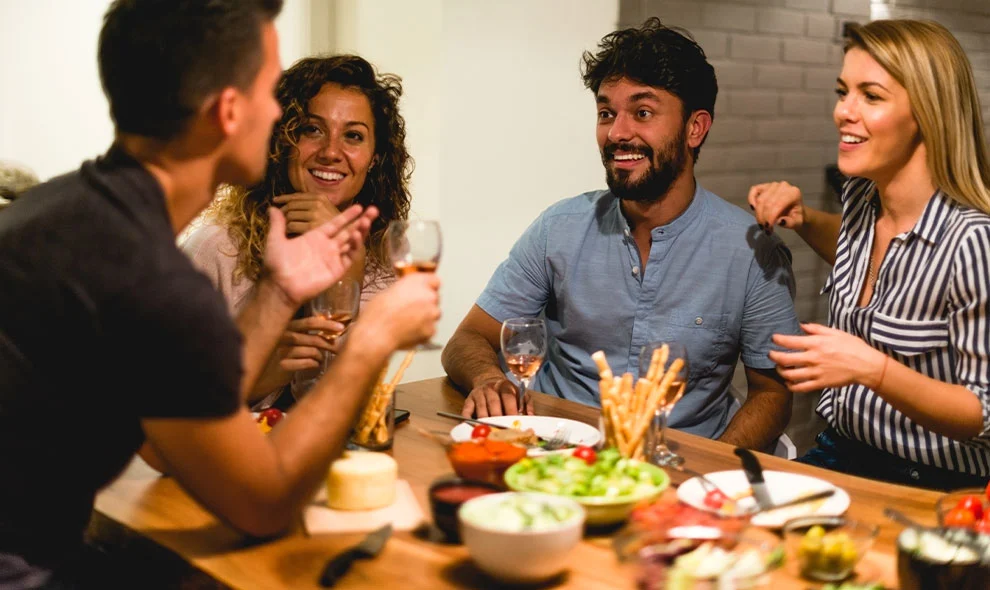
Real Experiences: Friendships that Begin with DineWho
Stories that begin around a table and building community in the city
Elif was a designer, thirty-two years old, who had moved to a new city. Her relationship with her colleagues was limited, and her old friends lived in other cities. One evening, she saw an.
There were six people at Massada. In the first few minutes, everyone was a little nervous. However, the atmosphere changed when one of the conversation cards was revealed: “What has surprised you the most recently?” Everyone answered the question in turn. One person's story of a radical departure from their job, another's late-blooming passion for music, Elif's decision to move cities… At the end of the evening, phones were exchanged, and plans for coffee the following week were made. Elif remembers that evening as “the first time she truly felt like she belonged somewhere in the city she had moved to.”.
The intersections of different lives: The modern neighbourhood experience
At DineWho tables, very different lives come together. At one table, a doctor might meet a programmer, a playwright a civil engineer, or someone who has lived in the city for a long time might meet someone who has just moved there. This diversity, at first glance, brings up the question, “Will we find common ground?”.
But the modern neighbourhood experience emerges right here. As everyone shares their stories, unexpected intersections emerge. Two people who grew up in the same neighbourhood meet at the same table years later. Another realises that someone else also went to the summer school they attended as a child. Thus, deep bonds, shared pasts, and similar feelings take root in city life.
How are sustainable bonds formed? Continuity for building community in the city
Many events leave a pleasant memory at the end of the evening. However, the real question is: how does that memory turn into a lasting connection? Building a community in the city requires continuity rather than short-term excitement.
DineWho participants often ensure this continuity through the following steps:
- At the end of the evening, they open a shared WhatsApp or a small message group.
- Those at the same table agree to meet again at the next DineWho gathering.
- Some groups also plan get-togethers outside of DineWho; they go to concerts together or arrange Sunday brunches.
These steps may not seem significant, but they keep relationships alive. Over time, this small group evolves into a modern neighbourhood core. People genuinely start to feel, “I have someone to call on when I need them.”.
For adults looking to build community in the city, these kinds of experiences show a new possibility: loneliness doesn't have to be an unchangeable destiny. The right environment, carefully chosen people and a safe table can open the door to a brand new social circle.
Perhaps you too have been thinking for a long time, “I wish I had a desk like that too.” You want to find your own community in the middle of the crowd in a modern city. Perhaps you keep postponing the first step. However, even joining a small co-working space can be enough to get started. A single evening spent in environments like DineWho can make the city a completely different place for you.


 English (UK)
 Türkçe