
Why Loneliness in the City Has Become Ordinary?
Closing doors From the apartment block to anonymity
On your way home in the evening in the big city, you may not notice the people you get in the same lift with. The door closes, you take off your shoes and your phone screen suddenly seems to be your only “friend” of the day. This scene has now become commonplace for many. The apartment blocks are full, the streets are crowded, but knocking on someone's door saying “put the tea on, I'm coming” is almost non-existent.
Many people who remember their childhood neighbourhood recall the plastic chairs set up in front of the door. Conversation flowed spontaneously, there was no need to plan. Now life does not flow without planning. Human relationships that cannot be placed on the calendar are gradually melting away. Thus, loneliness ceases to be a dramatic feeling and becomes part of the daily routine.
Yet people still want to connect. The unfamiliar faces sitting side by side at the DineWho table offer a small but powerful example of this. People living in the same city but unaware of each other's existence sit at the same table for a single evening. These people, who do not even make eye contact when walking side by side on the street, make eye contact at the table and open their stories.
What difference does one evening a week make?
When talking about loneliness, many people cling to the phrase “I don't have time”. However, one evening a week can be the first spark for building community. This evening works like a pause button that slows down a busy life. You sit at a table, look up from your phone and meet people in the city who feel the same way you do.
The point here is not to build a giant social circle. The real difference lies in turning one evening a week into an “autopilot” zone. This space looks tiny from the outside. However, over time, it reassures you and reminds you that “I am not alone”. Thus, the city gradually ceases to be a crowded but cold backdrop.
An evening at curated tables like DineWho provides a soft introduction to this transformation. Because everyone is here for the same reason: They want to spend a quiet, safe and cosy evening in the city, to let real ties be broken.
Is it Possible to Build Community One Evening a Week?
The nature of time and micro-meetings
In adulthood, social life often depends on the increased energy from work. For this reason, many people say, “I would like to see my friends more often”, but they stand still. Because the sentence is too big and life is too full. Instead of big goals, small but regular micro-meetings are more realistic.
Building a community one evening a week therefore provides a logical framework. It may be difficult to take an evening completely away from work. But a meal, a chat or a walk of just two or three hours makes the evening feel more possible. It's not the duration that matters, but the repetition. Once a rhythm is established, new people settle comfortably into the time.
DineWho The experience flows precisely with this “micro-meeting” logic. A dinner squeezed in between the busy week fits into the calendar without exaggeration. Those who come to the same table can share a real story in that short time. Because no one comes with the pressure of “eternal friendship”; everyone just wants to spend that evening more meaningfully.
Small, sustainable intentions to build community one evening a week
At this point, the question is: “So, how does one evening a week become a habit?” The answer lies in simplifying the intention. Most people feel obliged to rebuild their social life. However, small, flexible and sustainable intentions last longer.
For example, you can draw yourself a frame like this:
- One night a week, I try not to eat alone at home.
- At least once a month, I sit at the same table with new people.
- Instead of texting, I prefer to meet a friend face to face.
These intentions don't seem like challenging goals. But over time, it opens an invisible door to finding friends in the city. Because you add a “community space” into the weekly rhythm. Sometimes this space is a DineWho meeting, sometimes a long-postponed coffee with an old friend.

Deepening Conversations: Tips for Bonding
The importance of asking questions
Among the methods of meeting new people, the oldest but most effective tool is still the same: asking questions. Still, most conversations get stuck on the questions “Where are you from?” and “What do you do?”. These questions are not bad, they just open doors. As the connection deepens, the questions need to change slightly.
For example, if someone at the table is talking about their job, the following questions can make the conversation warmer:
- “What influenced the voters to choose that job?”
- “What relaxes you the most outside of work?”
- “Where is your favourite little escape in this city?”
Such questions reveal not only your identity card, but also your inner world. In adulthood, social life often remains on the surface. Because nobody wants to be misunderstood, nobody wants to appear “too much”. However, open-ended questions, asked gently, both open up space and create a sense of safe curiosity.
Creating safe space at the DineWho table
The DineWho experience offers an interesting ground at this point. Let's say there are four, six or eight people sitting at the table. No one knows each other, but everyone has come to share food and conversation. This establishes a common intention from the beginning.
At most DineWho tables, it's the little questions that break the ice. Short but meaningful questions like “What brought you here today?” or “When was the last time you felt truly connected in this city?” open the table. In such an environment, people don't feel they have to prove themselves. There is no competition, there is less pressure to perform.
One evening Aslı sits at a table through DineWho. She couldn't get out of the meetings all day long, in fact, she even thought about cancelling. The first question on the table is very simple: “What tired you the most this week, what relaxed you the most?” Aslı first plans to give a short answer. Then she realises that everyone at the table is really listening. At that moment, her indecision about changing jobs spills out of her tongue. No one judges her; everyone offers small pieces of their own story. That evening, Aslı returns home with the feeling that “there are people who understand me”.
It is precisely in these moments that community is built. When you set out to build community one evening a week, you are actually looking for safe spaces. The DineWho table is just one of those spaces. The important thing is that you give yourself permission for that evening and stay at the table.
Socialising in a Restaurant: Gateway to Intimate Communities
Influence of the environment and meeting at the table
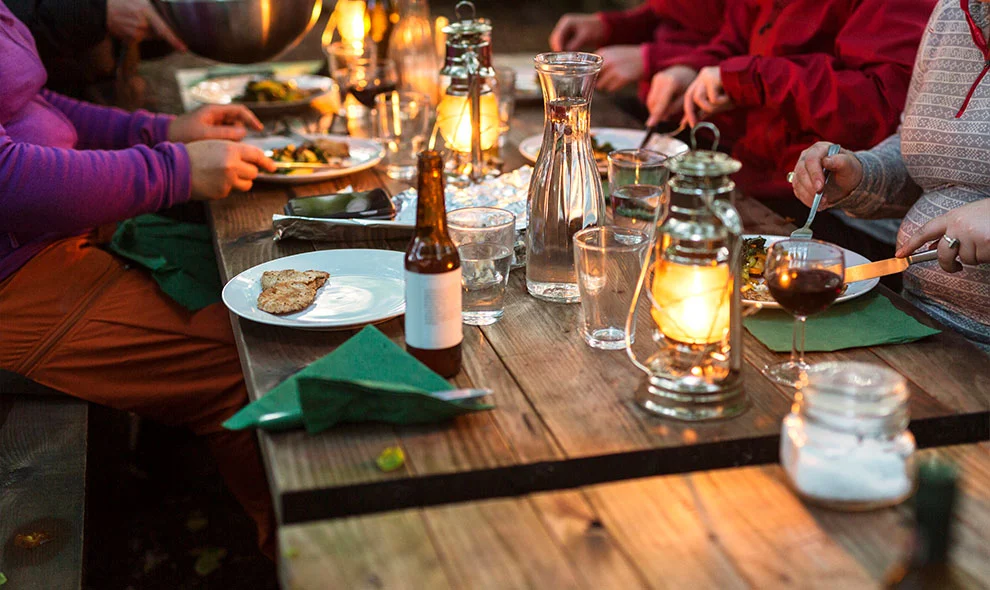
Socialising in a restaurant sounds both familiar and distant. Most people associate restaurants with couples or close groups of friends. However, sitting at a common table is a very natural starting point for intimate communities. As the plates, glasses and bread basket circulate around the table, so does the conversation.
The language of the environment affects relationships. If there is loud music, rushed service or a tense atmosphere, no one wants to open up. On the other hand, places where the light is soft, the sound does not drown each other out, and the menu does not feel complicated, open a door inwards. DineWho especially tries to observe this climate in the places it chooses. Thus, everyone who comes to the table at least does not have to fight with the environment.
In the city, deep friendships often blossom in such “neutral but warm” environments. When people feel safe, the walls of defence slowly come down. Someone at the table asks for water, another passes the salt, a third asks what is offered on the menu. Small gestures carry the silent beginnings of big bonds.
Shared food, shared story
The social eating experience has been bringing people together for thousands of years. Families gathering around the same pot, village tables, neighbourhood iftar meals... Although city life seems to be disintegrating this picture now, the power of the table is still there.
At a DineWho meal, a plate is brought out and everyone holds out their fork. “I'm trying it for the first time,” says one. “There is a dish like this in my hometown,” says another. From there, it is not difficult to reach childhood memories, family relationships and moving stories. Shared food builds a bridge to shared stories.
In the city, you don't need giant therapy sessions to deal with loneliness. Sometimes all you need is a few hours of space at a table where you don't feel the need to explain who you are to anyone. The people you meet at the table may not be your life partner or best friend tomorrow. But that evening gives you the feeling of “I am here and I have been seen”.
This feeling is at the heart of the idea of building community one evening a week. You don't have to meet the same people every week. But every week you can step into a table, a conversation, a sharing. After a while, the city goes beyond the streets you walk alone. The faces you greet at the corner and smile when you meet them multiply.
A Simple Roadmap for Building Community One Evening a Week
First week Observation and intention
Building a community is sometimes perceived as a big organisation. However, the only step for the first week can be to simply observe yourself and your city again. Which cafés, which parks, which restaurants are you curious about on your way home? Which evening do you really want to go out?
A small checklist can make your job easier:
- [Which evening this week do I feel the most energetic?
- [ ] Can I open a 2-3 hour window for that evening?
- [How does it feel to write “Shall I see you this week?” to someone I haven't called for a long time?
- [How does trying a curated social eating experience like DineWho make me feel right now?
You don't have to find clear answers to these questions. But just thinking about the answers will update your mind map about finding friends in the city. As intentions become clearer, opportunities become more visible.
Second and third week: Turning it into a routine
From the second week onwards, you can turn one evening of your choice into a small ritual. For example, you can call every Wednesday evening “bonding evening”. Sometimes this evening is reserved for meeting new people at the DineWho table. Sometimes you take a friend with you and share the same experience.
The important thing is to create an evening where you intend to look at faces instead of the phone screen. During these two to three weeks, you may notice the following:
- Feeling lighter after a chat, even if you are tired.
- To start remembering names, faces and small details.
- Feeling that “I might meet someone familiar” when walking in the city.
These realisations are very valuable for social life in adulthood. Because it is only after trying again that many people realise how much they have missed making connections.
Fourth week and beyond: Deepening the sense of community
In the fourth week, it may feel more natural to have community one evening a week. At this point you can make a small choice: Do you want to deepen with the same people, or do you want to discover new faces? Both are possible, both are valuable.
The DineWho experience offers the chance to meet different people at each table, and allows you to invite someone from the previous table back if you wish. Thus, the possibility of deep friendships in the city gradually materialises. One evening you just share a meal, another evening you talk about life decisions.
In time, it could be:
- You hear that two people you met at the same table are meeting without you.
- Coming out of a DineWho evening, the group plans to go on holiday together after months.
- One participant said that he found his first “safe space” in his new city at these tables.
These examples show how small evenings can change lives, without making big promises. You only set aside one evening a week. But that evening becomes a part of your life that expands with new people, new stories, new possibilities.
You might be open to trying small steps to explore one evening a week in the bustling city together. Sometimes it's at a DineWho table, sometimes it's at your favourite street café, sometimes it's on a park bench. The important thing is to give yourself permission: “I'm not alone in this city, and one night a week I can really do my best to build community.” The rest is already carried by the stories that unfold around the table and the laughter that is shared.


 English (UK)
 Türkçe